HCLTech Interview Questions 2026: Are you preparing for an HCLTech interview? This guide covers 100 HCLTech interview questions and answers for freshers and experienced candidates. The questions are useful for candidates applying for software engineering, IT support, service desk, testing, analyst, customer support, infrastructure, BPO, technical support, and other HCLTech jobs.
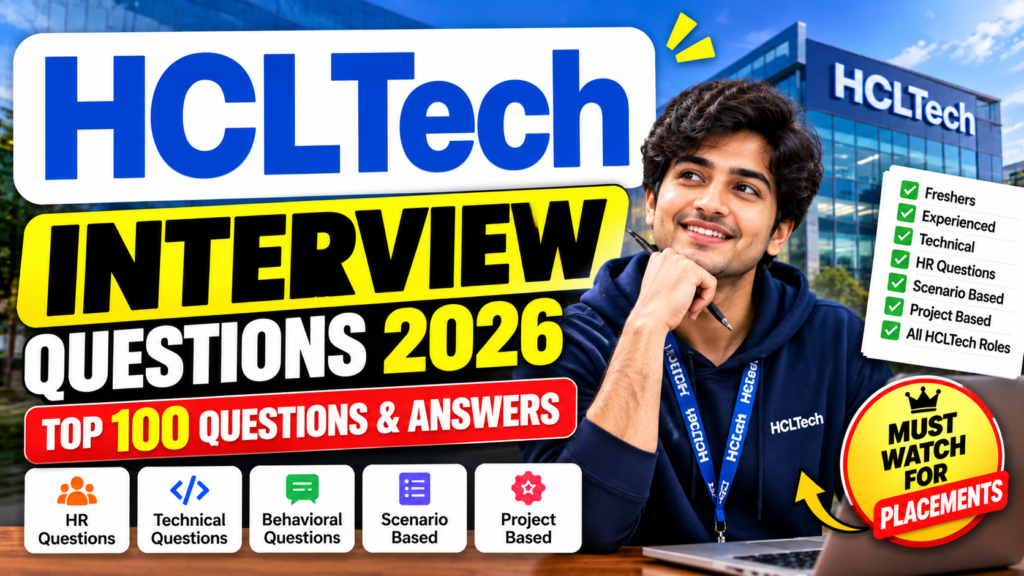
HCLTech hiring processes can vary depending on the job role, experience level, location, and business unit. Candidates may be evaluated through different stages, including application screening, aptitude or technical assessments, communication assessments, technical interviews, HR discussions, and role-specific evaluations.
If you are applying for an HCLTech fresher job, software engineer position, service desk role, technical support job, customer support position, or experienced IT role, this guide can help you understand the major areas you should prepare before attending an interview.
HCLTech Interview Process 2026
The HCLTech interview process can vary according to the role and hiring program.
A typical recruitment process may include:
- Online application
- Resume screening
- Aptitude or online assessment
- Technical assessment
- Communication or English assessment
- Technical interview
- Managerial interview, where applicable
- HR interview
- Document verification
- Final selection and offer
Freshers applying for entry-level technology positions should be prepared for questions related to programming fundamentals, databases, operating systems, networking, projects, communication, problem-solving, and basic technical concepts.
Candidates applying for non-technical roles may instead be evaluated more heavily on communication, customer handling, process knowledge, problem-solving, and situational questions.
100 HCLTech Interview Questions and Answers
Part 1: General HCLTech Interview Questions
1. Tell me about yourself.
Answer:
Give a short professional introduction covering your education, technical or functional skills, projects, internships, work experience, and career interests. Keep the answer relevant to the HCLTech position you are applying for.
2. Why do you want to join HCLTech?
Answer:
Explain your interest in technology, professional development, learning opportunities, client projects, and the specific position. Connect your skills with the responsibilities mentioned in the job description.
3. What do you know about HCLTech?
Answer:
HCLTech is a global technology company providing IT services and technology solutions to organizations across different industries. Its services cover areas such as digital transformation, cloud, cybersecurity, engineering, applications, infrastructure, data, and other technology services.
4. Why should we hire you?
Answer:
Explain how your technical knowledge, communication skills, willingness to learn, problem-solving ability, and relevant project or work experience can help you contribute to the organization.
5. What are your strengths?
Answer:
Mention two or three strengths relevant to the position, such as problem-solving, adaptability, communication, teamwork, technical learning, analytical thinking, or customer handling. Support at least one strength with an example.
6. What is your biggest weakness?
Answer:
Choose a genuine but manageable weakness and explain what you are doing to improve it. Avoid giving a weakness that directly conflicts with the main requirements of the position.
7. Where do you see yourself in five years?
Answer:
Explain that you want to build strong expertise, take on greater responsibilities, continuously improve your skills, and contribute to increasingly important projects.
8. Why did you choose your degree or specialization?
Answer:
Explain what interested you about the field and how your education helped you develop analytical, technical, or problem-solving skills.
9. Why are you looking for a job?
Answer:
For freshers, discuss your interest in starting your professional career and applying your skills in a real-world environment. Experienced candidates should focus on professional growth, learning, and broader responsibilities.
10. Are you willing to relocate?
Answer:
If you are comfortable relocating, clearly state that you are open to relocation based on business requirements. If you have restrictions, communicate them professionally.
Part 2: HCLTech HR Interview Questions
11. Why should we select you over other candidates?
Answer:
Focus on your relevant skills, willingness to learn, ability to adapt, communication, and problem-solving. Avoid comparing yourself negatively with other candidates.
12. Are you comfortable working in shifts?
Answer:
If the job description requires shifts and you are comfortable with them, confirm your flexibility. For roles supporting international clients, explain that you understand the need for business-aligned working hours.
13. Are you comfortable working from office?
Answer:
Answer honestly based on the requirements of the position. If you are comfortable with the company’s work arrangement, clearly state your flexibility.
14. What are your salary expectations?
Answer:
For freshers, you can state that you are open to the company’s standard compensation structure for the position while considering the role, responsibilities, and growth opportunities.
15. Are you willing to sign a service agreement if applicable?
Answer:
Review the actual employment terms carefully before agreeing. If the role includes a contractual commitment, understand its duration and conditions before accepting.
16. What motivates you?
Answer:
You can mention learning, solving problems, achieving measurable results, working with technology, helping customers, and taking on challenging responsibilities.
17. How do you handle pressure?
Answer:
Prioritize tasks, break large problems into smaller steps, focus on deadlines, communicate early when there are issues, and maintain accuracy.
18. How do you handle failure?
Answer:
Explain the situation honestly, identify what went wrong, describe how you corrected it, and explain what you learned.
19. How do you handle criticism?
Answer:
Listen carefully, understand the feedback, avoid becoming defensive, and use constructive feedback to improve your future performance.
20. What makes you a good team member?
Answer:
Good teamwork involves communication, reliability, respect for different opinions, willingness to help others, and focusing on the team’s overall objective.
- Amazon Interview Questions: Click Here
- Accenture Interview Questions: Click Here
- Cognizant Interview Questions: Click Here
Part 3: HCLTech Behavioral and Situational Questions
21. Tell me about a difficult problem you solved.
Answer:
Use a real example and explain the situation, your responsibility, the steps you took, and the final result.
22. Tell me about a time you worked in a team.
Answer:
Describe the team’s objective, your specific responsibility, how you collaborated, and the outcome.
23. Tell me about a conflict with a teammate.
Answer:
Explain the disagreement professionally and show how you communicated, understood the other person’s perspective, and reached a practical solution.
24. Tell me about a time you missed a deadline.
Answer:
Explain what caused the delay, how you communicated it, what action you took, and what you changed to avoid a similar problem.
25. Tell me about a time you learned something quickly.
Answer:
Explain what you needed to learn, how you learned it, how you applied it, and the result.
26. Tell me about a time you took responsibility.
Answer:
Describe a situation where you noticed an issue and took ownership instead of waiting for someone else to solve it.
27. Tell me about a time you helped someone.
Answer:
Explain the person’s problem, the support you provided, and how your assistance helped them achieve the required result.
28. How do you prioritize tasks?
Answer:
Consider deadlines, business impact, customer impact, dependencies, and urgency. Complete high-priority tasks first and communicate when priorities conflict.
29. What would you do if you disagreed with your manager?
Answer:
Present your viewpoint respectfully with facts, listen to your manager’s reasoning, and support the final decision professionally.
30. What would you do if you made a mistake at work?
Answer:
Take responsibility, inform the relevant person, correct the issue quickly, understand the root cause, and take steps to prevent it from happening again.
Part 4: HCLTech Technical Interview Questions for Freshers
31. What is a programming language?
Answer:
A programming language provides a structured way for developers to write instructions that computers can execute.
32. What is the difference between a compiler and an interpreter?
Answer:
A compiler generally translates a program into machine or intermediate code before execution, while an interpreter generally executes instructions progressively during runtime. The exact behavior depends on the language and implementation.
33. What is an algorithm?
Answer:
An algorithm is a sequence of steps used to solve a problem or perform a computation.
34. What is a data structure?
Answer:
A data structure organizes and stores data so that it can be accessed and modified efficiently.
35. What is an array?
Answer:
An array stores a collection of elements, generally of the same type, in an indexed structure.
36. What is a linked list?
Answer:
A linked list consists of nodes where each node stores data and a reference to another node.
37. What is a stack?
Answer:
A stack follows the LIFO — Last In, First Out principle.
38. What is a queue?
Answer:
A queue generally follows the FIFO — First In, First Out principle.
39. What is a binary tree?
Answer:
A binary tree is a tree data structure where each node can have at most two children.
40. What is a binary search tree?
Answer:
A binary search tree maintains an ordering where values smaller than a node are generally stored in its left subtree and larger values in its right subtree.
41. What is time complexity?
Answer:
Time complexity describes how an algorithm’s running time changes as the input size increases.
42. What is Big-O notation?
Answer:
Big-O notation describes the upper-bound growth rate of an algorithm’s resource requirements, commonly used for time or space complexity.
43. What is recursion?
Answer:
Recursion occurs when a function calls itself to solve smaller instances of a problem. A base case is required to stop the recursive calls.
44. What is object-oriented programming?
Answer:
Object-oriented programming organizes software around objects containing data and behavior. Important concepts include encapsulation, inheritance, abstraction, and polymorphism.
45. What is inheritance?
Answer:
Inheritance allows one class to acquire or extend properties and behaviors of another class.
46. What is polymorphism?
Answer:
Polymorphism allows the same interface or method concept to have different implementations or behaviors.
47. What is encapsulation?
Answer:
Encapsulation combines data and methods and controls access to the internal state of an object.
48. What is abstraction?
Answer:
Abstraction hides unnecessary implementation details and exposes the functionality required by the user.
49. What is exception handling?
Answer:
Exception handling is a mechanism for detecting and managing runtime errors so that a program can respond appropriately rather than terminating unexpectedly.
50. What is debugging?
Answer:
Debugging is the process of identifying, analyzing, and fixing errors or unexpected behavior in software.
Part 5: HCLTech Java, Python and Programming Questions
51. What is the difference between C, C++ and Java?
Answer:
C is primarily procedural, C++ supports both procedural and object-oriented programming, while Java is primarily object-oriented and runs through the Java Virtual Machine.
52. What is Python?
Answer:
Python is a high-level programming language known for readable syntax and a broad ecosystem used in software development, automation, data analysis, artificial intelligence, and other areas.
53. What is Java?
Answer:
Java is a widely used programming language and platform commonly used for enterprise applications, backend systems, Android development historically, and many other software applications.
54. What is a class?
Answer:
A class is a blueprint that defines data and behavior that objects created from the class can have.
55. What is an object?
Answer:
An object is an instance of a class containing state and behavior defined by that class.
56. What is method overloading?
Answer:
Method overloading occurs when multiple methods have the same name but different parameter lists within an applicable language context.
57. What is method overriding?
Answer:
Method overriding occurs when a subclass provides its own implementation of a method inherited from a parent class.
58. What is a constructor?
Answer:
A constructor is a special mechanism used to initialize an object when it is created.
59. What is a variable?
Answer:
A variable is a named reference or storage location used to hold a value that a program can work with.
60. What is the difference between syntax and logical errors?
Answer:
Syntax errors violate the programming language’s rules and generally prevent successful compilation or parsing. Logical errors occur when the program runs but produces an incorrect result.
Part 6: HCLTech SQL and Database Interview Questions
61. What is DBMS?
Answer:
A Database Management System is software used to create, store, retrieve, update, and manage data in databases.
62. What is RDBMS?
Answer:
A Relational Database Management System stores data in related tables and commonly uses SQL for database operations.
63. What is SQL?
Answer:
SQL stands for Structured Query Language and is used to interact with relational databases.
64. What is a primary key?
Answer:
A primary key uniquely identifies a record in a database table.
65. What is a foreign key?
Answer:
A foreign key is a column or group of columns used to establish a relationship between tables by referencing a key in another table.
66. What is normalization?
Answer:
Normalization organizes database structures to reduce unnecessary duplication and improve data integrity.
67. What is a JOIN?
Answer:
A JOIN combines related records from multiple tables based on a specified relationship or condition.
68. What is the difference between INNER JOIN and LEFT JOIN?
Answer:
INNER JOIN returns matching records between tables. LEFT JOIN returns every record from the left table and matching records from the right table where available.
69. What is a database index?
Answer:
An index is a data structure that can improve the speed of data retrieval operations, although indexes also require storage and can increase the cost of certain write operations.
70. What is a transaction?
Answer:
A transaction is a logical unit of database work that should be completed according to the database’s transaction rules. ACID properties are commonly associated with reliable database transactions.
Part 7: HCLTech Networking and IT Support Questions
71. What is an IP address?
Answer:
An IP address identifies a device or network interface on an IP network and allows network communication.
72. What is DNS?
Answer:
DNS, or Domain Name System, translates human-readable domain names into IP addresses and other DNS records.
73. What is DHCP?
Answer:
DHCP automatically provides network configuration information such as IP addresses to devices on a network.
74. What is HTTP?
Answer:
HTTP is an application-layer protocol used for communication between clients and web servers.
75. What is HTTPS?
Answer:
HTTPS is HTTP transmitted over a secure TLS connection, providing encryption and authentication mechanisms.
76. What is a firewall?
Answer:
A firewall controls network traffic according to defined security rules and can help prevent unauthorized access.
77. What is a VPN?
Answer:
A VPN creates a protected network connection over another network, commonly using encryption to secure traffic.
78. What is ping?
Answer:
Ping is a network diagnostic utility commonly used to test whether a destination can be reached and to measure round-trip response time.
79. What is the difference between LAN and WAN?
Answer:
A LAN generally covers a limited geographical area such as an office, while a WAN connects networks across larger geographical areas.
80. What is an operating system?
Answer:
An operating system manages computer hardware and provides services and interfaces that allow applications to run.
Part 8: HCLTech Service Desk and Customer Support Questions
These questions are especially useful for candidates applying for HCLTech Service Desk, Technical Support, Customer Support, Voice Process, and similar positions.
81. What is a service desk?
Answer:
A service desk is a central point where users can report technical issues, request assistance, receive information, and track support requests.
82. How would you handle an angry customer?
Answer:
Remain calm, listen carefully, acknowledge the concern, identify the issue, explain the available solution, and follow the appropriate support process.
83. What would you do if you cannot resolve a technical issue?
Answer:
Perform the approved troubleshooting steps, document the issue and actions already taken, and escalate it to the appropriate team according to the escalation process.
84. What is ticket escalation?
Answer:
Ticket escalation means transferring an unresolved issue to a team or support level with the required expertise or authority.
85. What is SLA?
Answer:
SLA stands for Service Level Agreement. It defines agreed service expectations, which can include response time, resolution targets, availability, and other service commitments.
86. How would you troubleshoot a user who cannot access the internet?
Answer:
Check the physical or wireless connection, verify network configuration, test connectivity, check DNS-related issues, test another website or device where appropriate, and escalate if the issue requires higher-level support.
87. What would you do if a user’s computer is slow?
Answer:
Check resource usage, running applications, available storage, startup programs, network dependency, recent changes, and security alerts while following the organization’s troubleshooting procedures.
88. What is remote troubleshooting?
Answer:
Remote troubleshooting involves diagnosing and resolving a user’s technical issue without being physically present at the user’s location.
89. Why is documentation important in IT support?
Answer:
Documentation records the issue, troubleshooting steps, resolution, and relevant information. This helps with future troubleshooting, knowledge sharing, auditing, and consistent support.
90. How do you prioritize support tickets?
Answer:
Prioritize according to factors such as business impact, number of affected users, urgency, service criticality, and SLA requirements.
Part 9: HCLTech Final HR and Situational Questions
91. Are you comfortable working with international clients?
Answer:
If you are comfortable, explain that you can communicate professionally with customers or clients from different regions and adapt to their requirements.
92. Are you comfortable working in a team?
Answer:
Yes. Explain that you value communication, collaboration, knowledge sharing, and accountability.
93. How do you handle repetitive tasks?
Answer:
Maintain accuracy and consistency while looking for approved ways to improve efficiency and productivity.
94. What would you do if you were given a task you had never performed before?
Answer:
Understand the requirements, research the appropriate resources, ask relevant questions, learn the necessary skills, and complete the task according to the expected process.
95. What would you do if you received two urgent tasks?
Answer:
Assess their impact, deadlines, dependencies, and priority. If both genuinely require immediate attention, communicate with the relevant manager or stakeholders to establish the correct priority.
96. How do you manage your time?
Answer:
Plan tasks based on priority and deadlines, break larger activities into smaller steps, and track progress throughout the day.
97. What are your career goals?
Answer:
Explain that you want to build strong technical or functional expertise, continuously learn, contribute to projects, and gradually take on greater responsibilities.
98. What questions would you ask the interviewer?
Answer:
Ask questions about the team, role expectations, training, technology or processes used, performance expectations, and growth opportunities.
99. Why should we hire a fresher?
Answer:
A fresher can bring strong learning ability, adaptability, current academic knowledge, enthusiasm, and a willingness to develop according to organizational requirements.
100. Do you have any questions for us?
Answer:
Yes. Prepare two or three questions about the role, team, training, expectations, and career development. Asking relevant questions demonstrates preparation and genuine interest.
More Interview Preparation
Looking for more interview preparation resources? Explore our detailed interview guides for leading IT companies and prepare for HR, technical, coding, SQL, and behavioral interview rounds.
- Amazon Interview Questions: Click Here
- HCLTech Interview Questions: Click Here
- Accenture Interview Questions: Click Here
- Cognizant Interview Questions: Click Here
For more latest job updates, interview questions, fresher opportunities, and off-campus hiring information, Click Here to visit FindMyJobss.
HCLTech Interview Preparation Tips for Freshers
Getting selected in an HCLTech interview is not only about memorizing questions. Candidates should understand the job description and be able to explain their own skills and experiences.
1. Understand Your Resume
Interviewers can ask questions about anything mentioned on your resume.
If you mention:
- Java
- Python
- SQL
- AWS
- Testing
- Linux
- Networking
- React
- Projects
- Internships
be prepared to explain the fundamentals.
2. Prepare Your Projects
Freshers should be able to explain:
- Project objective
- Your role
- Technologies used
- Database used
- Major features
- Challenges
- Your contribution
- Testing
- Final outcome
- Future improvements
Do not simply memorize the project description.
3. Practice Technical Fundamentals
For IT and software roles, revise:
- Programming
- OOP
- Data structures
- Algorithms
- DBMS
- SQL
- Operating systems
- Computer networks
- Software engineering
- Cloud fundamentals
- Basic cybersecurity
4. Improve Communication
For service desk, support, BPO, voice, and customer-facing positions, communication is especially important.
Practice explaining technical issues in simple language.
5. Prepare Situational Questions
Think about real examples involving:
- Teamwork
- Deadlines
- Conflict
- Failure
- Customer complaints
- Problem-solving
- Leadership
- Learning
- Mistakes
- Difficult situations
6. Research the Job Description
The preparation should match the position.
For example:
Software Engineer:
Focus on coding, programming, data structures, algorithms, databases, OOP, projects, and technical problem-solving.
Service Desk:
Focus on troubleshooting, networking, operating systems, ticketing, SLA, communication, and customer handling.
Customer Support:
Focus on communication, customer service, problem-solving, and situational questions.
Testing:
Focus on manual testing, SDLC, STLC, test cases, defect management, automation basics, and programming fundamentals where applicable.
HCLTech Interview Questions for Freshers
Freshers should not try to memorize all 100 questions.
Instead, prepare these important areas:
Technical
- OOP
- SQL
- DBMS
- Data structures
- Algorithms
- Operating systems
- Networking
- Programming language fundamentals
Resume
- Academic projects
- Internships
- Certifications
- Technical skills
- Final-year project
HR
- Tell me about yourself
- Why HCLTech?
- Why should we hire you?
- Strengths and weaknesses
- Relocation
- Shift flexibility
- Career goals
Situational
- Team conflict
- Difficult deadline
- Failure
- Customer complaint
- Mistake
- Problem-solving
HCLTech Interview Questions for Experienced Candidates
Experienced candidates should focus less on textbook definitions and more on their actual work experience.
Be prepared to explain:
- Your current project
- Your responsibilities
- Technologies used
- Architecture
- Production issues
- Performance improvements
- Client interactions
- Team size
- Challenges
- Technical decisions
- Problem resolution
- Automation
- Process improvements
- Metrics and results
Interviewers may also ask follow-up questions based on anything written on your resume.
HCLTech Technical Interview Preparation
Candidates applying for technical positions should practice solving problems while explaining their thought process.
For coding questions, be prepared to discuss:
- Problem understanding
- Approach
- Data structure
- Algorithm
- Complexity
- Edge cases
- Testing
- Possible optimization
For database questions, practice writing SQL queries involving:
- SELECT
- WHERE
- GROUP BY
- HAVING
- ORDER BY
- JOIN
- Subqueries
- Aggregate functions
- Window functions
- Duplicate detection
For networking and IT support positions, revise:
- TCP/IP
- DNS
- DHCP
- HTTP/HTTPS
- VPN
- Firewall
- IP addressing
- Troubleshooting
- Windows/Linux fundamentals
Frequently Asked Questions About HCLTech Interviews
Is the HCLTech interview difficult?
The difficulty depends on the position, candidate’s experience, hiring program, and evaluation stage. Technical positions generally require stronger technical preparation, while support and customer-facing positions can focus more on communication, troubleshooting, and situational skills.
Does HCLTech conduct interviews for freshers?
Yes, HCLTech regularly has opportunities and hiring programs for entry-level candidates, although eligibility and hiring requirements vary by recruitment drive.
What questions are asked in HCLTech interviews?
Questions can cover programming, SQL, DBMS, networking, operating systems, projects, communication, HR topics, customer handling, and role-specific skills.
Is coding asked in HCLTech interviews?
Coding can be relevant for software development and technical positions. The level and type of coding questions depend on the role and hiring process.
What should freshers prepare for HCLTech?
Freshers should prepare programming fundamentals, OOP, SQL, DBMS, data structures, operating systems, networking, projects, communication, and HR questions.
Does HCLTech ask HR questions?
Candidates can encounter HR and behavioral questions depending on the hiring process and role.
Are these exact HCLTech interview questions?
No. These are preparation questions designed around common interview topics. Actual questions may vary by role, location, experience, and recruitment process.
Final Words
Preparing for an HCLTech interview becomes easier when you focus on the requirements of the position instead of memorizing answers.
Freshers should concentrate on technical fundamentals, projects, communication, problem-solving, and HR questions. Experienced professionals should additionally prepare detailed discussions around their previous projects, technical decisions, responsibilities, challenges, and achievements.
For software roles, practice programming, SQL, data structures, algorithms, OOP, operating systems, networking, and project-based questions.
For service desk and customer support roles, focus on troubleshooting, communication, customer handling, ticket management, SLA, and situational questions.
Use these 100 HCLTech interview questions as a preparation checklist and adapt your answers to your own education, experience, projects, and the exact job description.
Candidates should also check the latest HCLTech job description and official recruitment information before attending an interview because hiring processes and eligibility requirements can change.
Good preparation is not about memorizing 100 answers. It is about being able to explain your skills, decisions, experiences, and problem-solving approach confidently.
Related: Check the latest HCLTech hiring opportunities and other fresher and experienced job openings on FindMyJobss.com.
Important: These are interview preparation questions based on common HCLTech role requirements and interview topics. They are not leaked or guaranteed interview questions. The actual interview can vary depending on the position and hiring team.