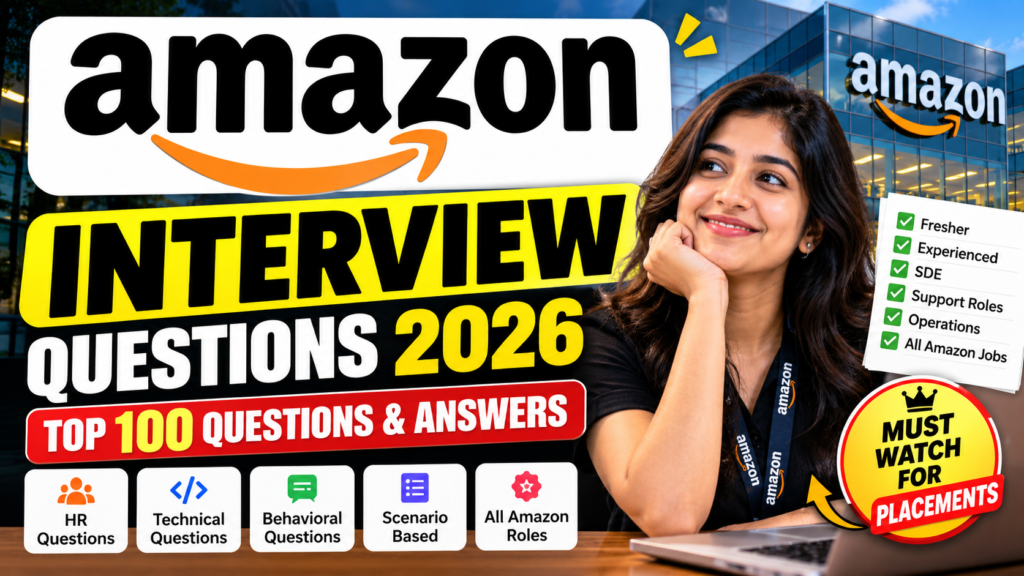
Amazon Interview Questions 2026: Preparing for an Amazon interview? This guide covers 100 Amazon interview questions and answers that can help freshers, experienced professionals, software developers, customer service candidates, data analysts, business analysts, operations candidates, and other job seekers prepare for Amazon hiring in 2026.
Amazon conducts interviews differently depending on the position. Candidates applying for software development roles may face coding, data structures, algorithms, system design, and behavioral questions, while non-technical roles can focus more heavily on communication, problem-solving, customer handling, ownership, and role-specific skills. Amazon’s official hiring resources also explain that the interview process can include applications, assessments, phone screening, and interview loops depending on the position.
If you are applying for Amazon Software Development Engineer I, Customer Service Associate, Data Associate, Business Analyst, Quality Associate, Cloud Support Associate, Operations, or another Amazon position, this article can help you understand the types of questions you may encounter and how to prepare.
Amazon Interview Process 2026
The Amazon hiring process depends on the position. Candidates may go through some combination of an online application, assessment, phone screening, technical interview, behavioral interview, and interview loop. Amazon’s official hiring information confirms that its process differs from role to role.
For university and graduate SDE roles, Amazon says the online assessment is an important part of the process and includes coding evaluation. Amazon also recommends candidates prepare computer science fundamentals and practice solving coding problems.
For many roles, candidates should be prepared for questions involving:
- Introduction and resume
- Behavioral situations
- Customer handling
- Problem-solving
- Leadership Principles
- Communication
- Role-specific technical knowledge
- Coding and algorithms for technical roles
- System design for applicable engineering roles
- Projects and previous experience
Amazon Interview Questions for Freshers
Freshers should focus on understanding their resume, academic projects, internships, programming fundamentals, communication skills, and examples that demonstrate ownership and problem-solving.
Here are 100 questions divided into different categories so candidates can prepare according to their Amazon job role.
100 Amazon Interview Questions and Answers
Part 1: General Amazon Interview Questions
1. Tell me about yourself.
Answer:
Give a short professional introduction covering your education, relevant skills, projects, internships, work experience, and why you are interested in the position. Keep the answer focused on information relevant to the job rather than personal details.
2. Why do you want to work at Amazon?
Answer:
A strong answer should explain your interest in Amazon’s technology, customer-focused culture, scale, learning opportunities, and the specific position you applied for. Connect your skills and career goals with the requirements of the role.
3. Why should we hire you?
Answer:
Explain three things: your relevant skills, your ability to learn and solve problems, and how you can contribute to the team. Support your answer with a project, internship, work example, or measurable achievement.
4. What do you know about Amazon?
Answer:
Amazon is a global company operating across e-commerce, cloud computing, digital services, advertising, logistics, artificial intelligence, devices, and other technology areas. Candidates should also understand the responsibilities of the specific role they applied for.
5. What are your strengths?
Answer:
Choose strengths relevant to the position, such as problem-solving, communication, analytical thinking, programming, customer handling, ownership, adaptability, or teamwork. Give a brief example demonstrating the strength.
6. What is your biggest weakness?
Answer:
Choose a genuine but manageable weakness and explain what you are doing to improve it. Avoid giving a weakness that directly prevents you from performing the job.
7. Where do you see yourself in five years?
Answer:
Explain how you want to develop professionally, take on greater responsibility, improve your technical or functional skills, and contribute to the organization.
8. Why are you looking for a job change?
Answer:
Keep the answer professional. Focus on career growth, learning opportunities, broader responsibilities, or finding a role that better matches your skills.
9. What motivates you?
Answer:
Discuss factors such as solving challenging problems, learning new technologies, helping customers, achieving measurable results, or taking ownership of important projects.
10. How do you handle pressure?
Answer:
Explain how you prioritize tasks, break large problems into smaller activities, communicate when necessary, and focus on completing high-priority work accurately.
Part 2: Amazon Leadership and Behavioral Questions
Behavioral questions are important in Amazon interviews. Amazon’s official interview guidance says candidates should prepare examples from their previous experiences and structure answers using the STAR method: Situation, Task, Action, Result.
11. Tell me about a time you took ownership of a problem.
Answer:
Use a real example where you noticed a problem, took responsibility without waiting for someone else, implemented a solution, and achieved a measurable result.
12. Tell me about a time you solved a difficult problem.
Answer:
Explain the situation, why the problem was difficult, the options you considered, the action you took, and the final outcome.
13. Tell me about a time you made a mistake.
Answer:
Be honest about the mistake. Explain what caused it, how you corrected it, and what process you changed afterward to prevent it from happening again.
14. Tell me about a time you failed.
Answer:
Choose a genuine example and focus more on what you learned and how you improved afterward.
15. Tell me about a time you disagreed with your manager.
Answer:
Explain your viewpoint respectfully, use facts or data to support your position, listen to the manager’s perspective, and describe how the final decision was handled professionally.
16. Tell me about a conflict with a teammate.
Answer:
Explain how you identified the cause of the disagreement, communicated directly, focused on the project objective, and reached a practical solution.
17. Tell me about a time you worked under a tight deadline.
Answer:
Describe how you prioritized the most important tasks, removed unnecessary work, communicated expectations, and delivered the result.
18. Tell me about a time you improved a process.
Answer:
Describe the old process, identify the inefficiency, explain your improvement, and provide measurable results where possible.
19. Tell me about a time you used data to make a decision.
Answer:
Explain what information you collected, how you analyzed it, what alternatives you considered, and how the data influenced your decision.
20. Tell me about a time you went beyond your responsibilities.
Answer:
Describe a situation where you identified an important need outside your normal responsibilities and voluntarily helped solve it.
21. Tell me about a time you helped a teammate.
Answer:
Explain the teammate’s challenge, how you supported them, and what happened as a result.
22. Tell me about a time you had to learn something quickly.
Answer:
Explain what you needed to learn, how you learned it, how you applied the knowledge, and the outcome.
23. Tell me about a time you disagreed with a team decision.
Answer:
Explain your reasoning respectfully, listen to other opinions, use facts where possible, and support the final decision once it has been made.
24. Tell me about a time you received negative feedback.
Answer:
Explain the feedback, how you responded, what you changed, and how the change improved your performance.
25. Tell me about a time you delivered a result despite limited resources.
Answer:
Explain the constraints and how you prioritized the most important activities to achieve the required outcome.
26. How do you prioritize multiple tasks?
Answer:
Consider urgency, business or customer impact, dependencies, deadlines, and effort. Complete high-impact tasks first and communicate early when priorities conflict.
27. How do you handle an ambiguous problem?
Answer:
Start by clarifying the objective, identify assumptions, gather relevant information, break the problem into smaller parts, and develop a solution that can be improved as more information becomes available.
28. How do you handle criticism?
Answer:
Listen without becoming defensive, identify useful points, ask questions if needed, and apply the feedback to improve future performance.
29. Describe a situation where you demonstrated leadership.
Answer:
Leadership does not necessarily require a formal management position. Explain how you influenced others, took responsibility, solved a problem, or helped a team achieve an important goal.
30. What does customer obsession mean to you?
Answer:
It means understanding the customer’s actual need, identifying pain points, making decisions based on customer impact, and continuously improving the experience.
- HCLTech Interview Questions: Click Here
- Accenture Interview Questions: Click Here
- Cognizant Interview Questions: Click Here
Part 3: Amazon Software Development Engineer Interview Questions
For SDE positions, Amazon’s published preparation material highlights areas including programming languages, data structures, algorithms, coding, object-oriented design, databases, distributed computing, operating systems, internet topics, and machine learning/AI.
31. What is the difference between an array and a linked list?
Answer:
An array stores elements in contiguous memory and generally provides fast index-based access. A linked list consists of nodes connected through references and can efficiently insert or remove elements when the relevant position is known.
32. What is a stack?
Answer:
A stack is a linear data structure that follows LIFO — Last In, First Out. Common operations include push, pop, and peek.
33. What is a queue?
Answer:
A queue follows FIFO — First In, First Out. Elements are generally inserted at the rear and removed from the front.
34. What is a hash table?
Answer:
A hash table stores key-value pairs and uses a hash function to determine where data should be stored. With a good hash function, lookup, insertion, and deletion can often be performed in approximately O(1) average time.
35. What is a binary search tree?
Answer:
A binary search tree is a tree in which values smaller than a node are generally placed in its left subtree and larger values in its right subtree.
36. What is the difference between BFS and DFS?
Answer:
Breadth-first search explores nodes level by level and commonly uses a queue. Depth-first search explores as deeply as possible before backtracking and can use recursion or a stack.
37. What is time complexity?
Answer:
Time complexity describes how the running time of an algorithm grows as the input size increases. Big-O notation is commonly used to express this growth.
38. What is space complexity?
Answer:
Space complexity measures how much additional memory an algorithm requires as the input size grows.
39. What is recursion?
Answer:
Recursion occurs when a function calls itself to solve smaller versions of the same problem. A proper base condition is required to stop the recursion.
40. What is dynamic programming?
Answer:
Dynamic programming solves problems by breaking them into overlapping subproblems and storing previously calculated results to avoid repeated computation.
41. What is an algorithm?
Answer:
An algorithm is a defined sequence of steps used to solve a problem or perform a computation.
42. What is object-oriented programming?
Answer:
Object-oriented programming organizes software around objects containing data and behavior. Common concepts include encapsulation, inheritance, polymorphism, and abstraction.
43. What is inheritance?
Answer:
Inheritance allows a class to acquire properties and behavior from another class, helping developers reuse and extend existing functionality.
44. What is polymorphism?
Answer:
Polymorphism allows the same interface or method concept to behave differently depending on the object or implementation.
45. What is encapsulation?
Answer:
Encapsulation combines data and related methods while controlling how internal data can be accessed or modified.
46. What is abstraction?
Answer:
Abstraction hides unnecessary implementation details and exposes only the important functionality needed by the user or another component.
47. What is a database index?
Answer:
A database index is a data structure that helps the database find records more efficiently without scanning the entire table in many cases.
48. What is normalization?
Answer:
Normalization organizes relational database data to reduce unnecessary duplication and improve data integrity.
49. What is a primary key?
Answer:
A primary key uniquely identifies each record in a database table.
50. What is the difference between SQL and NoSQL databases?
Answer:
SQL databases generally use structured relational tables and SQL queries, while NoSQL databases can use models such as documents, key-value pairs, columns, or graphs and are often designed for different scalability and data-model requirements.
Part 4: Amazon Coding and Problem-Solving Questions
51. How would you find duplicate elements in an array?
Answer:
A common approach is to use a hash set to track values already encountered. When a value is already present in the set, it is a duplicate.
52. How would you reverse a linked list?
Answer:
Maintain references such as previous, current, and next. Iterate through the list while reversing each node’s pointer until the end is reached.
53. How would you find the largest element in an array?
Answer:
Initialize a variable with the first element and iterate through the array, updating the variable whenever a larger value is found.
54. How would you check whether a string is a palindrome?
Answer:
Compare characters from opposite ends moving toward the center, or reverse the string and compare it with the original.
55. How would you find the first non-repeating character?
Answer:
Count the frequency of every character and then scan the string again to find the first character whose frequency is one.
56. How would you merge two sorted arrays?
Answer:
Use two pointers, compare the current elements, append the smaller one to the result, and continue until both arrays are processed.
57. How would you detect a cycle in a linked list?
Answer:
Floyd’s cycle detection algorithm uses two pointers moving at different speeds. If they meet, a cycle exists.
58. How would you implement binary search?
Answer:
Maintain left and right boundaries, calculate the middle position, compare the middle value with the target, and eliminate half of the search space repeatedly.
59. How would you find the second-largest number?
Answer:
Maintain the largest and second-largest values while scanning the array once, carefully handling duplicate values and edge cases.
60. How do you optimize an algorithm?
Answer:
First understand the current time and space complexity. Then look for unnecessary loops, repeated calculations, inefficient data structures, and opportunities to reduce computation or memory usage.
Part 5: Amazon System Design Questions
System design is particularly relevant to engineering and senior technical roles. Amazon’s official preparation material emphasizes scalability, reliability, efficiency, practicality, and optimization when discussing system design.
61. How would you design a URL shortener?
Answer:
Discuss the requirements, URL generation, database structure, API design, caching, scalability, collision handling, and availability. Explain trade-offs rather than jumping directly into implementation.
62. How would you design an online shopping system?
Answer:
Identify components such as product catalog, search, user accounts, cart, inventory, payment, order management, notifications, and databases. Explain how they communicate and scale.
63. How would you design a notification system?
Answer:
Consider notification producers, queues, delivery workers, user preferences, retries, rate limits, monitoring, and channels such as email, SMS, or push notifications.
64. What is horizontal scaling?
Answer:
Horizontal scaling adds more servers or instances to handle increased workload instead of simply making one server more powerful.
65. What is vertical scaling?
Answer:
Vertical scaling increases the resources of an existing machine, such as CPU, memory, or storage.
66. What is caching?
Answer:
Caching stores frequently accessed information in a faster storage layer so future requests can be served more quickly.
67. What is a load balancer?
Answer:
A load balancer distributes incoming requests across multiple servers or services to improve availability, performance, and scalability.
68. What is fault tolerance?
Answer:
Fault tolerance is the ability of a system to continue operating when some components fail.
69. What is high availability?
Answer:
High availability means designing systems to remain accessible and operational with minimal downtime.
70. What is eventual consistency?
Answer:
Eventual consistency means that distributed replicas may temporarily contain different values but will converge to the same state if updates stop.
Part 6: Amazon Customer Service Interview Questions
These questions are especially useful for candidates applying for Customer Service Associate, Customer Support, Seller Support, and related non-technical Amazon jobs.
71. How would you handle an angry customer?
Answer:
Listen carefully, remain calm, acknowledge the customer’s concern, understand the issue, explain the available solution, and take appropriate action according to company policies.
72. What would you do if you did not know the answer to a customer’s question?
Answer:
Do not provide incorrect information. Explain that you will verify the information, consult the appropriate resource or team, and then provide the customer with an accurate answer.
73. How do you handle repetitive work?
Answer:
Maintain consistency and accuracy while looking for ways to improve efficiency without compromising quality.
74. What is good customer service?
Answer:
Good customer service means understanding the customer’s issue, communicating clearly, resolving the problem efficiently, and ensuring the customer receives accurate information.
75. How would you handle multiple customers or tasks at the same time?
Answer:
Prioritize based on urgency and impact, follow established processes, keep accurate records, and avoid sacrificing quality for speed.
76. What would you do if a customer asks for something against company policy?
Answer:
Politely explain the applicable policy and look for an alternative solution that is allowed under the company’s guidelines.
77. How do you handle negative feedback from customers?
Answer:
Treat the feedback as useful information, identify the underlying issue, address it professionally, and use the experience to improve future interactions.
78. How important is communication in customer service?
Answer:
Communication is critical because customers need clear, accurate, and respectful information. Good communication can prevent misunderstandings and improve customer satisfaction.
79. What would you do if a customer keeps repeating the same complaint?
Answer:
Remain patient, acknowledge the concern, summarize the issue to confirm understanding, and clearly explain the next action or available resolution.
80. Why do you want to work in customer service?
Answer:
Explain your interest in communication, problem-solving, helping customers, and developing professional skills in a customer-focused environment.
Part 7: Amazon Data, Business and Operations Interview Questions
81. What is the difference between data and information?
Answer:
Data consists of raw facts or observations, while information is processed and interpreted data that provides useful meaning.
82. What is SQL?
Answer:
SQL, or Structured Query Language, is used to communicate with relational databases and perform operations such as retrieving, inserting, updating, and deleting data.
83. What is a JOIN in SQL?
Answer:
A JOIN combines rows from two or more tables based on a related column or condition.
84. What is the difference between INNER JOIN and LEFT JOIN?
Answer:
An INNER JOIN returns matching records from both tables. A LEFT JOIN returns all records from the left table and matching records from the right table when available.
85. What is a KPI?
Answer:
A Key Performance Indicator is a measurable value used to evaluate progress toward a specific business or operational objective.
86. How do you analyze a large dataset?
Answer:
Start by understanding the business question, clean and validate the data, explore patterns, perform relevant analysis, visualize important findings, and communicate conclusions clearly.
87. What is data cleaning?
Answer:
Data cleaning involves identifying and correcting problems such as missing values, duplicate records, inconsistent formats, incorrect entries, and invalid data.
88. How would you investigate a sudden drop in sales?
Answer:
First verify that the data is correct. Then segment the change by product, location, customer type, channel, time period, and other relevant dimensions to identify where the decline originated.
89. How do you prioritize operational problems?
Answer:
Consider customer impact, business impact, urgency, frequency, risk, and resources required to solve the issue.
90. What would you do if your analysis contradicted your manager’s assumption?
Answer:
Present the data objectively, explain the methodology, verify the analysis, listen to alternative viewpoints, and work together to determine the most accurate conclusion.
Part 8: Additional Amazon Interview Questions
91. What are Amazon Leadership Principles?
Answer:
Amazon uses Leadership Principles as a framework for how employees make decisions, solve problems, work with others, and serve customers. Candidates should review the current official Leadership Principles before an interview.
92. What is the STAR method?
Answer:
STAR stands for:
- Situation – Explain the context.
- Task – Describe your responsibility.
- Action – Explain what you personally did.
- Result – Describe the outcome.
Amazon’s interview preparation resources specifically recommend structured examples and the STAR method for behavioral preparation.
93. What is your biggest professional achievement?
Answer:
Choose an achievement relevant to the role and explain the challenge, your contribution, and the measurable result.
94. Describe a project you are proud of.
Answer:
Explain the project’s purpose, your role, technologies or methods used, challenges faced, and the final result.
95. What was the most difficult part of your project?
Answer:
Identify a genuine technical, operational, or teamwork challenge and explain how you solved it.
96. How do you learn a new technology?
Answer:
Start with official documentation and fundamentals, build a small practical project, experiment with the technology, and then apply it to a real problem.
97. How do you ensure quality in your work?
Answer:
Use clear requirements, validation, testing, reviews, documentation, monitoring, and feedback. The exact methods depend on the position.
98. What questions would you ask the interviewer?
Answer:
Ask thoughtful questions about the team, role expectations, learning opportunities, success metrics, projects, challenges, and the next stage of the hiring process.
99. Why should Amazon select you over other candidates?
Answer:
Do not criticize other candidates. Instead, explain the combination of your relevant skills, learning ability, problem-solving approach, experience, and interest in the position.
100. Do you have any questions for us?
Answer:
Yes. Prepare two or three questions in advance. For example, ask what success looks like in the first six months, what challenges the team is currently solving, or what skills are most important for the role.
More Interview Preparation
Looking for more interview preparation resources? Explore our detailed interview guides for leading IT companies and prepare for HR, technical, coding, SQL, and behavioral interview rounds.
- Amazon Interview Questions: Click Here
- HCLTech Interview Questions: Click Here
- Accenture Interview Questions: Click Here
- Cognizant Interview Questions: Click Here
For more latest job updates, interview questions, fresher opportunities, and off-campus hiring information, Click Here to visit FindMyJobss.
Amazon Interview Preparation Tips for 2026
Preparing 100 questions is useful, but simply memorizing answers is not the best approach. Amazon’s own interview resources emphasize applying knowledge to solve problems and discussing real experiences rather than memorizing responses.
1. Understand the Job Description
Read the job description carefully and identify the technical skills, qualifications, responsibilities, and preferred skills.
For example, an Amazon Software Development Engineer I candidate should pay particular attention to programming, data structures, algorithms, object-oriented design, databases, and problem-solving.
2. Prepare Your Resume
Every project, skill, internship, and achievement on your resume can become an interview discussion point.
Do not list technologies you cannot explain.
3. Prepare STAR Stories
Prepare several real examples covering:
- A difficult problem
- A failure
- A success
- A conflict
- A tight deadline
- A process improvement
- A customer problem
- A leadership experience
- A mistake
- A situation where you learned something quickly
4. Practice Coding Without Depending Completely on an IDE
For software development positions, practice writing syntactically correct code and explaining your approach. Amazon’s official SDE preparation material recommends practicing coding and evaluating solutions for efficiency, reliability, robustness, and edge cases.
5. Explain Your Thinking
During technical interviews, do not simply give the final answer.
Explain:
- Your understanding of the problem
- Your assumptions
- Your approach
- Alternative approaches
- Time complexity
- Space complexity
- Edge cases
- Testing strategy
6. Research the Role
An Amazon SDE interview is different from an Amazon Customer Service interview. Similarly, Data Analyst, Business Analyst, Cloud Support, Operations, QA, and other positions can have different evaluation areas.
Prepare according to the actual job description.
7. Use Official Amazon Resources
Candidates should always verify current interview information through Amazon’s official careers resources because hiring processes can change.
Amazon provides official resources covering its hiring process, interview preparation, software development interview topics, online assessments, and other technical roles.
Amazon Interview Questions for Freshers: What Should You Study?
If you are a fresher, focus on the following areas:
For Software Development roles:
- Programming fundamentals
- Data structures
- Algorithms
- Object-oriented programming
- SQL and databases
- Operating systems
- Computer networks
- Problem-solving
- Basic system design
- Projects
- Behavioral questions
For Customer Service roles:
- Communication
- Customer handling
- Problem-solving
- Basic computer skills
- Situational questions
- Work flexibility
- Conflict resolution
For Data and Business roles:
- SQL
- Excel
- Data analysis
- Business concepts
- KPIs
- Problem-solving
- Communication
- Projects
For Operations roles:
- Process management
- Problem-solving
- Quality
- Productivity
- Customer focus
- Situational questions
- Communication
Amazon Interview Questions for Experienced Candidates
Experienced candidates should prepare questions around their previous projects, ownership, decision-making, technical depth, stakeholder management, leadership, failures, and measurable results.
Be prepared to explain:
- What you personally contributed
- Why you selected a particular solution
- Technical trade-offs
- Performance improvements
- Challenges
- Production issues
- Customer impact
- Team collaboration
- Metrics
- Lessons learned
For senior software engineering roles, Amazon’s official preparation resources place additional emphasis on coding, system design, scalability, reliability, and behavioral examples.
Amazon Interview Questions: Frequently Asked Questions
Is Amazon interview difficult?
The difficulty depends on the position, level, team, and candidate’s background. Technical roles can require coding and problem-solving, while non-technical positions may place greater emphasis on communication, customer handling, and role-specific skills.
Does Amazon ask coding questions?
Coding is relevant to many software development roles. Amazon’s official SDE preparation resources specifically discuss coding assessments, algorithms, data structures, and software development topics.
Does Amazon ask behavioral questions?
Yes. Behavioral interviewing is an important part of many Amazon hiring processes. Candidates should prepare examples from their experiences and be ready to explain what they did and what happened as a result.
What is the STAR method for Amazon interviews?
STAR means Situation, Task, Action, and Result. It provides a structured way to explain behavioral examples.
Are these the exact Amazon interview questions?
No. These are preparation questions designed to help candidates practice common interview areas. Actual Amazon interview questions can vary by role, team, location, and hiring process.
How should freshers prepare for an Amazon interview?
Freshers should understand their resume and projects, review role-specific fundamentals, practice problem-solving, prepare behavioral examples, and study the requirements in the Amazon job description.
Does every Amazon job have the same interview process?
No. Amazon states that its application and interview process differs from role to role.
Final Words
Amazon interviews can be challenging, but structured preparation can make the process much easier. Instead of memorizing 100 answers, use these questions to practice explaining your own experiences, projects, skills, decisions, and problem-solving approach.
For Amazon SDE roles, focus strongly on coding, data structures, algorithms, databases, object-oriented design, and problem-solving. For customer service and operations roles, focus on communication, customer handling, ownership, prioritization, and situational questions. For data and business positions, prepare SQL, analytics, business scenarios, and communication.
Most importantly, always check the official Amazon job description and Amazon Jobs interview resources for the position you are applying for because the actual process can vary by role.
Good preparation should help you enter the interview with a clear understanding of your own skills rather than relying on memorized answers.
Related: Candidates can also check the latest job opportunities and hiring updates available on FindMyJobss.com.
Official Amazon Interview Resources
- Amazon How We Hire
- Amazon Software Development Interview Topics
- Amazon SDE Online Assessment Preparation
- Amazon Interview Preparation FAQ
- Amazon Interview Loop
Use the official Amazon resources above to verify the latest interview information before your interview.
Important: These are practice and preparation questions, not leaked or guaranteed Amazon interview questions. The actual questions can vary by job, team, location, experience level, and hiring process.